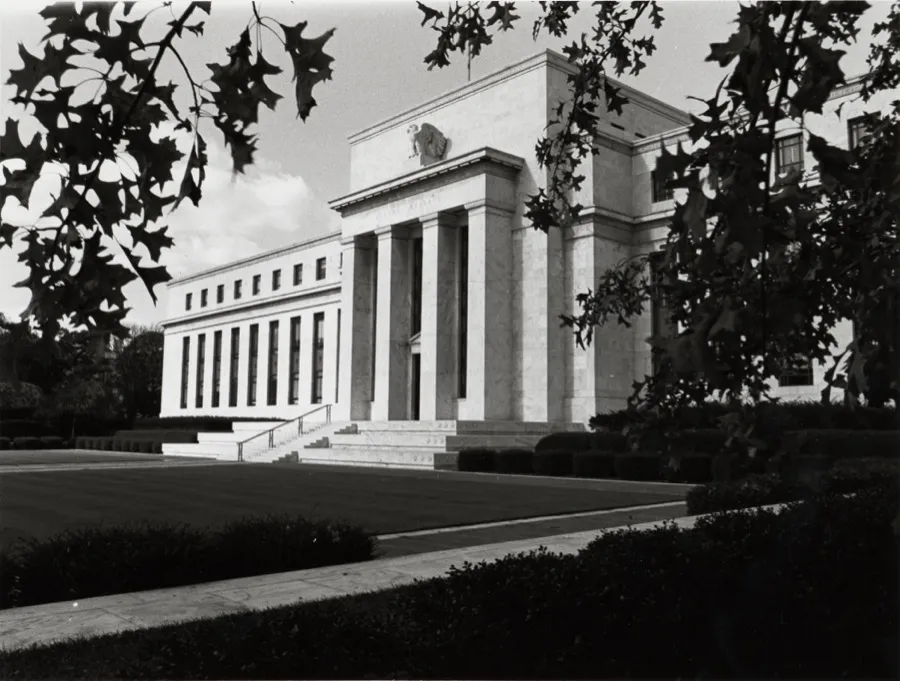
Photo: Board of Governors of the Federal Reserve System — public domain.
Syllabus
An undergraduate course in intermediate macroeconomics, covering the classical/neoclassical toolkit for aggregate analysis — long-run growth, consumption and savings, investment, and the labour market — building up to the IS–LM and AD–AS frameworks used to study short-run fluctuations and policy.
Evaluation: exam (50%), in-class quizzes (30%), problem sets (20%).
Textbook: no textbook was required; most material follows Macroeconomics, 8th Canadian edition, by Abel, Bernanke, Croushore, and Kneebone, with Macroeconomics, 7th edition, by N. Gregory Mankiw, as a secondary reference.
| # | Topic |
|---|---|
| 1 | Introduction: macroeconomic questions, data, and measurement |
| 2 | Long-run growth and the Solow model |
| 3 | Consumption and savings |
| 4 | Investment |
| 5 | Investment–savings equilibrium (IS) |
| 6 | The labour market |
| 7 | Money market equilibrium (LM) |
| 8 | Aggregate demand and supply (AD–AS) |
Course materials
Lecture slides, handout format (PDF).
- Introductory Class — course overview and an introduction to macroeconomics: the field’s central questions, and macro data on economic activity, prices, the exchange rate, and interest rates. PDF
- Economic Growth — data and facts on long-run growth, the aggregate production function, growth accounting, and the dynamics of capital accumulation in the Solow model. PDF
- Consumption and Savings — a two-period consumption–savings model, its dynamics, and the role of government spending and taxes (Ricardian equivalence). PDF
- Investment — a model of investment demand, covering the user cost of capital and its comparative statics. PDF
- Investment–Savings Equilibrium (IS) — goods-market clearing, the Keynesian cross, fiscal multipliers, and the derivation of the IS curve. PDF
- Labour Market — labour demand and supply, market equilibrium and comparative statics, and unemployment and the FE line. PDF
- Money Market Equilibrium (LM) — money supply and demand, and money-market equilibrium underlying the LM curve. PDF
- Aggregate Demand and Supply (AD–AS) — the aggregate demand and supply curves, short- vs. long-run equilibrium, and the effect of economic policy on short-run fluctuations. PDF
Course references
Books
- Abel, A. B., B. Bernanke, R. D. Kneebone, and D. D. Croushore (2018). Macroeconomics, 8th Canadian ed. Pearson Education Canada. Link
- Barro, R. J., and X. Sala-i-Martin (2003). Economic Growth, 2nd ed. The MIT Press.
- Borjas, G. J. (2019). Labor Economics, 8th ed. McGraw-Hill.
- Mankiw, N. G. (2009). Macroeconomics, 7th ed. Worth Publishers. Link
- Powell, J. (2005). A History of the Canadian Dollar, 2nd ed. Bank of Canada. Link
- Romer, D. (2018). Advanced Macroeconomics, 5th ed. McGraw-Hill. Link
Papers
- Acemoglu, D. (2007). Introduction to Modern Economic Growth. Levine’s Bibliography, UCLA Department of Economics.
- Attanasio, O. P. (1999). “Consumption.” In Handbook of Macroeconomics, Vol. 1, 741–812. Elsevier. Link
- Bordo, M. D. (2007). “A Brief History of Central Banks.” Economic Commentary (Dec). Link
- Caballero, R. (1999). “Aggregate Investment.” In Handbook of Macroeconomics, ed. J. B. Taylor and M. Woodford, Vol. 1, Part B, 813–862. Elsevier. Link
- Caselli, F. (2005). “Accounting for Cross-Country Income Differences.” In Handbook of Economic Growth, Vol. 1, 679–741. Elsevier.
- Deaton, A. (2005). “Franco Modigliani and the Life-Cycle Theory of Consumption.” BNL Quarterly Review 58(233–234): 91–107. Link
- Friedman, M. (1957). “The Permanent Income Hypothesis.” In A Theory of the Consumption Function, 20–37. National Bureau of Economic Research. Link
- Goldfeld, S. M., and D. E. Sichel (1990). “The Demand for Money.” In Handbook of Monetary Economics, Vol. 1, 299–356. Elsevier. Link
- Hayashi, F. (1982). “Tobin’s Marginal q and Average q: A Neoclassical Interpretation.” Econometrica 50(1): 213–224. Link
- Jones, C. I. (2016). “The Facts of Economic Growth.” In Handbook of Macroeconomics, Vol. 2, 3–69. Elsevier.
- Jones, C. I., and P. J. Klenow (2016). “Beyond GDP? Welfare across Countries and Time.” American Economic Review 106(9): 2426–2457. Link
- Jones, C. I., and P. M. Romer (2010). “The New Kaldor Facts: Ideas, Institutions, Population, and Human Capital.” American Economic Journal: Macroeconomics 2(1): 224–245.
- Kaldor, N. (1961). “Capital Accumulation and Economic Growth.” In The Theory of Capital, ed. F. A. Lutz and D. C. Hague, 177–222. St. Martin’s Press.
- Lebergott, S. (1957). “Annual Estimates of Unemployment in the United States, 1900–1954.” In The Measurement and Behavior of Unemployment, 211–242. National Bureau of Economic Research. Link
- Mankiw, N. G. (1982). “Hall’s Consumption Hypothesis and Durable Goods.” Journal of Monetary Economics 10(Nov): 417–426.
- McLeay, M., A. Radia, and R. Thomas (2014). “Money Creation in the Modern Economy.” Bank of England Quarterly Bulletin 54(1): 14–27. Link
- Modigliani, F., and R. Brumberg (1954). “Utility Analysis and the Consumption Function: An Interpretation of Cross-Section Data.” In Post-Keynesian Economics, ed. K. K. Kurihara, 388–436. Rutgers University Press.
- Poole, W. (1970). “Optimal Choice of Monetary Policy Instruments in a Simple Stochastic Macro Model.” The Quarterly Journal of Economics 84(2): 197–216.
- Solow, R. M. (1956). “A Contribution to the Theory of Economic Growth.” The Quarterly Journal of Economics 70(1): 65–94. Link
- Solow, R. M. (1999). “Neoclassical Growth Theory.” In Handbook of Macroeconomics, Vol. 1, 637–667. Elsevier.
- Swan, T. W. (1956). “Economic Growth and Capital Accumulation.” The Economic Record 32(2): 334–361.
- Tobin, J. (1969). “A General Equilibrium Approach to Monetary Theory.” Journal of Money, Credit and Banking 1(1): 15–29. Link
Download the full set, for use with reference managers or LaTeX:
- BibTeX (.bib) — for LaTeX / BibTeX workflows.
- RIS (.ris) — for Zotero, EndNote, Mendeley, and most other reference managers.
- CSL-JSON (.json) — for Pandoc/Quarto and other CSL-aware citation tools.
- Reading list (PDF) — a typeset, alphabetized bibliography.